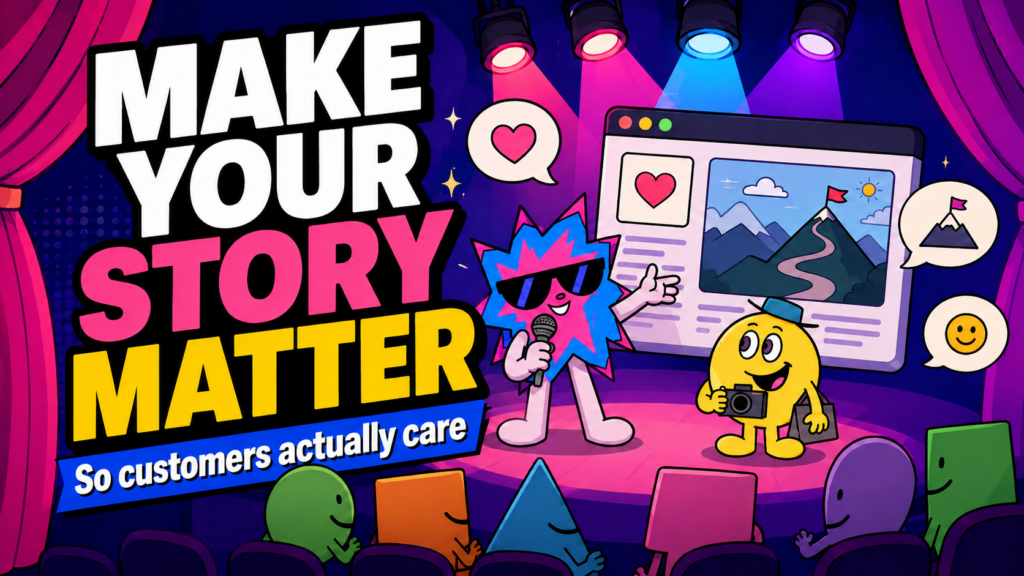
Quick answer Tell your brand story by making the customer the main character, not your company. Start with what they want, name the problem in their way, show that you understand it and can help, give them a simple plan, support your promise with proof, and make the next step clear. Your history still matters, but only after visitors understand why it makes you the right guide for their journey.
Key takeaways
- A brand story is not a long company biography. It is the clear explanation of who you help, what they want, what is making that harder, and how your business can help.
- Make the visitor feel understood before you explain your company. Strong storytelling is specific, relevant, and built around the questions people are already asking themselves.
- Your copy, proof, visuals, page order, internal links, and calls to action should all reinforce the same story instead of pulling the reader in different directions.
Why Your Brand Story Matters
A website can have good colours, smooth animations, and a polished logo, yet still leave visitors thinking, “Okay, but why should I care?” That is usually not a visual-design problem. It is a story problem.
Your brand story gives people a reason to keep reading. It connects what you offer to the goal they are already trying to achieve, explains why their current situation is frustrating, and makes your business feel relevant before they need to dig through five pages of company information.
The opening matters because people usually scan before they commit to reading. In an older Nielsen Norman Group analysis of 45,237 cleaned page views, visitors had time to read at most 28% of the text on an average page visit, with around 20% considered more realistic. It is not a permanent rule for every audience, but it is a useful reminder that your clearest message cannot be hidden under a dramatic image or halfway down the page. [Source: Nielsen Norman Group]
A good brand story earns attention by helping people quickly recognise three things: “This is for someone like me”, “they understand what I am dealing with”, and “they may be able to help me move forward.”
Related reading: How to Build a High-Converting Website: 15 Proven Elements [add internal link before publishing]
What a Brand Story Actually Is
A brand story is not a timeline of when your business started, how passionate you are, or how many awards you have collected. Those things may be useful later, but they are not the main story a new visitor needs first.
A useful brand story explains the relationship between a visitor’s goal and your business’s role in helping them reach it. It should make the offer easier to understand, not turn the website into a movie trailer.
| Weak brand story | Useful brand story |
| “We started in 2018 with a passion for innovation.” | “We help service businesses turn confusing websites into clear, credible journeys that bring in more enquiries.” |
| The company is always the hero. | The customer is the hero. The company is the guide with a useful role to play. |
| A collection of broad claims and adjectives. | A clear explanation of the problem, the outcome, the proof, and the next step. |
| History appears before relevance. | History appears when it helps explain empathy, expertise, or the reason you can solve the problem. |
The simplest test is this: after reading the first screen, can the visitor explain what they are trying to achieve, how you can help, and what action makes sense next? If not, the story needs more clarity.
Do Not Confuse Your Brand Story With Company History
Your company history can be valuable. It may explain why you care about the problem, show that you have lived through the same frustration, or demonstrate experience that makes your approach more credible. The mistake is making people read the whole origin story before they know why it matters to them.
Think of your history as evidence, not the opening act. Include it when it supports one of these questions:
- Why does this business understand the customer’s situation?
- What experience led to this approach?
- What makes the business credible enough to guide the customer?
- What belief or standard shapes the way the company works?
For example, an interior designer does not need to begin with a full autobiography. A better opening may explain how they help homeowners create spaces that are easier to live in, then use their experience and process as proof that they can deliver it.
Start With the Customer’s Desired Outcome
The customer should be the main character of the story. That does not mean your business becomes invisible. It means you enter the story as the guide, rather than expecting the visitor to care about your company before you have shown how it connects to their life or work.
Start by defining what the visitor is actually trying to achieve. Go beyond basic demographics. “Small-business owners aged 30 to 50” is not yet a useful story. “A business owner who knows their current website makes them look less credible than their competitors” is much closer to a real decision.
Ask:
- What does this person want to achieve or avoid?
- What would a better outcome look like in practical terms?
- What emotion sits underneath the practical goal: relief, confidence, pride, certainty, speed, or control?
- What would make them feel that they chose well?
When you can describe the goal clearly, your copy becomes more useful. You stop listing features and start explaining why those features matter.
Name the Problem Worth Solving
A story needs tension. On a website, that does not mean manufacturing drama. It means naming the problem the visitor is already trying to solve.
At Nebulon, we find it useful to look at three layers of a problem:
| Problem layer | What it means on the website |
| External problem | The practical issue the visitor can point to, such as a slow website, unclear service offering, inconsistent brand, or weak conversion flow. |
| Internal problem | The frustration or feeling created by the practical issue, such as embarrassment, uncertainty, overwhelm, or the fear of being overlooked. |
| Philosophical problem | The deeper belief that makes the customer’s problem feel unfair or worth solving, such as: “A good business should not be held back by a confusing website.” |
You do not need to use all three layers in every line of copy. But knowing them helps your message feel more human. It tells the visitor that you understand both the task in front of them and the reason it matters.
Position Your Business as the Guide
Most companies are tempted to present themselves as the hero: “We are the best”, “we are award-winning”, “we have the strongest team”. Some proof is important, but leading with self-praise can make the page feel like it is talking at people instead of helping them.
A better role is the guide. A guide does two things: they show empathy for the problem and demonstrate that they have a credible way to help.
| A useful balance Empathy without authority feels kind but unconvincing. Authority without empathy can feel cold or self-important. A strong brand story needs both. |
Instead of writing “We are a world-class agency”, explain the situation you understand and the practical result you help create. Then support it with evidence: your process, specific experience, a clear point of view, testimonials, project details, certifications, or client-approved results.
Use Empathy and Authority Together
Empathy means showing the visitor that you recognise what the problem feels like. Authority means giving them a reason to believe you can help. Both need to be specific.
| Weak phrasing | Stronger phrasing |
| “We care about your success.” | “A slow, unclear website can make a strong business look less capable than it really is. We build the story, structure, and performance foundations so visitors can understand your value quickly.” |
| “Our experienced team delivers results.” | “We begin by mapping the customer’s decision, then build the page around the questions, proof, and calls to action they need before they are ready to enquire.” |
The stronger versions do not make bigger promises. They make clearer ones. They explain what you understand and what you actually do.
Give Visitors a Simple Plan
People often hesitate because the next step feels unclear, expensive, time-consuming, or risky. A simple plan reduces that uncertainty. It tells visitors what working with you looks like without making them decode the process themselves.
For most service websites, a three-step plan is enough:
- Share what you need or what is not working.
- Receive a clear recommendation or proposal.
- Move forward with a structured process and defined next steps.
The plan should be real. Do not invent a three-step process merely because it looks neat on a page. Use the actual sequence your business follows, then explain it in language that makes the decision feel manageable.
Make the Call to Action Clear
A brand story needs a next chapter. That is what the CTA is for. Once you have clarified the goal, named the problem, shown your role, and reduced doubt, do not make visitors guess how to move forward.
A clear CTA tells people what will happen when they click. “Book a Free Website Strategy Call” is more useful than “Get Started” because it gives the visitor a clearer expectation.
Use different CTA strengths for different stages:
- Direct CTA: Book a consultation, request a quote, start your project.
- Transitional CTA: View the process, see pricing guidance, read a relevant guide.
- Low-friction CTA: Download a checklist, compare options, see examples.
Related reading: How to Write Website Buttons and CTAs That Get More Enquiries [add internal link before publishing]
Show Success and the Cost of Doing Nothing
People decide when they can picture a better outcome and understand why the current problem is worth addressing. Your story should show both, but it should never use fear for its own sake.
Success should be specific and believable. Instead of saying “transform your business”, describe what changes in the real world: a clearer offer, an easier buying process, more confidence sharing the website, a smoother customer journey, or fewer repeated questions from leads.
The cost of doing nothing can be equally practical: a confusing service page keeps attracting the wrong enquiries, a slow website wastes campaign spend, or an unclear brand makes the business harder to remember. This is not about pressure. It is about helping visitors make an informed decision.
Turn the Story Into a Homepage Flow
A brand story should not live only in an About page. It should shape the way the homepage unfolds, especially for visitors who arrive with little context.
A practical service-business homepage flow often looks like this:
| Page moment | What it should communicate |
| 1. Clear opening | State what you do, who it is for, and the outcome you help create. |
| 2. The problem | Name the frustration or missed opportunity the visitor recognises. |
| 3. The better outcome | Show what becomes easier, clearer, or more valuable once the problem is solved. |
| 4. The guide | Explain your approach with empathy and credible proof. |
| 5. The plan | Make working with you feel understandable and manageable. |
| 6. Proof | Place testimonials, process details, examples, or results where the visitor is likely to need reassurance. |
| 7. Clear next step | Invite the visitor to take the action that fits their readiness. |
This is not a rigid template. A restaurant, ecommerce store, charity, or B2B service may require a different emphasis. The principle stays the same: each section should answer the next sensible question in the visitor’s mind.
Related reading: How to Structure Your Website So Visitors Know What to Do Next [add internal link before publishing]
Make the Story Visible in Design
Copy carries the logic of the story, but the design should make that logic easier to feel. A strong heading should get attention. A supporting line should explain it. Proof should feel close enough to the claim it supports. A CTA should be easy to spot when the reader is ready.
Your images, type, colour, spacing, layout, motion, and overall tone should reinforce the same idea. A calm financial-planning brand should not rely on chaotic visuals. A playful kids’ brand should not sound like a corporate law firm. The design does not need to illustrate every sentence, but it should make the story feel consistent and believable.
Be careful with beautiful visuals that add no context. Nielsen Norman Group notes that link labels, summaries, and representative images help users decide whether a destination is relevant. The image should not be decorative at the expense of clarity. [Source: Nielsen Norman Group]
Keep the Story Honest, Specific, and Useful
The best brand story is not the most dramatic one. It is the one that feels true. Avoid broad promises such as “we transform everything” or “we are passionate about excellence” unless you can show what those phrases mean in real work.
Use clear language, direct examples, and proof that belongs to your business. Google’s people-first content guidance encourages original information, clear sourcing, demonstrable expertise, and visible authorship. That aligns with a useful brand-story principle: tell people what you know, why you know it, and how it helps them. [Source: Google Search Central]
This is also where E-E-A-T becomes practical. E-E-A-T stands for Experience, Expertise, Authoritativeness, and Trustworthiness. In simple terms, it is about giving readers clear reasons to trust that the person behind the article understands the topic and is being honest about what they know.
Add a real author name, explain the process behind your claims, show examples you are allowed to share, and cite reliable sources for facts. Most importantly, do not manufacture results, testimonials, or project outcomes just to make the story feel bigger. A smaller, truthful example is far more credible than an impressive-sounding claim you cannot prove.
Related reading: 10 Tips That Will Make Your Website Look More Trustworthy Instantly [add internal link before publishing]
Test Whether the Story Makes Sense
It is hard to judge your own website because you already know the business. Ask someone unfamiliar with it to look at the homepage for a minute, then ask:
- What do you think this business helps people do?
- Who do you think it is for?
- What problem do you think it solves?
- Why would someone trust it?
- What would you do next if you were interested?
If their answers are vague, do not immediately add more copy. First, check whether the opening message, proof, and CTA are in the right order. Strong storytelling usually feels simple to the visitor because the page has removed the need for them to interpret everything themselves.
How Nebulon Approaches Brand Storytelling
At Nebulon, we use a StoryBrand-inspired approach before we begin designing sections. We start by understanding the visitor’s goal, the problem in the way, the doubts that may slow their decision, and the outcome they want to reach. Then we define the role the business can honestly play in helping them get there.
We use the framework twice. First, it helps us arrange the sitemap and page flow. We decide what the visitor needs to understand before they see a service, proof point, process, or CTA. Then we use it again when planning the copy, so the page feels like a guided conversation instead of a collection of claims.
The ideal result is not a dramatic script. It is a website that feels like the company is reading the visitor’s mind: it names the problem they have been trying to explain, answers the questions they were about to ask, and gives them a clear way forward.
| A personal tip from Nebulon Do not make the company the main character just because it is your website. Make the visitor feel like they are in the right place, then give them a reason to trust your role in the story. |
Quick Brand Story Checklist
| Check | Question to ask |
| Customer | Can the visitor quickly see that the page is for someone like them? |
| Goal | Have we explained what the visitor wants to achieve or avoid? |
| Problem | Have we named the practical problem and the frustration behind it? |
| Guide | Does the business show both empathy and credible authority? |
| Plan | Is the process clear enough that the next step feels manageable? |
| Proof | Does every major claim have a relevant proof point nearby? |
| CTA | Does the action tell visitors what happens next? |
| Design | Do the visuals, tone, hierarchy, and layout reinforce the same story? |
| Truth | Are the examples, results, and promises specific and verifiable? |
Frequently Asked Questions
What should a brand story include?
A useful brand story should explain who the customer is, what they want, what problem is in the way, how the business can help, why it is credible, what the process looks like, and what action the visitor should take next.
Should my company history be on the homepage?
Only if it helps the visitor understand why you are relevant or credible. Most visitors need the offer and the outcome first. Your history can support the story later on an About page, credibility section, or founder note.
What is the difference between a brand story and a value proposition?
A value proposition is the short promise that explains what you offer, who it is for, and why it matters. A brand story is the wider journey that gives that promise context through the visitor’s goal, problem, proof, process, and next step.
Can a small business have a strong brand story?
Yes. Small businesses often have an advantage because they can be more specific about their customers, their point of view, and the real reason they do the work. The story does not need to be grand. It needs to be clear and true.
How do I know whether my brand story is working?
Ask a new visitor what the business does, who it is for, what problem it solves, and what they would do next. Then review behaviour data, enquiries, and common sales questions to see where the story is still unclear.
Final Thoughts
Your brand story is not there to make your business sound grander than it is. It is there to make the right people feel understood, give them confidence in your role, and make the path forward easier to see.
Start with the visitor’s goal. Name the problem clearly. Show empathy and authority. Give them a believable plan. Support your claims with proof. Then make the next step clear enough that they do not need to think twice about what to do.
A good website makes people look. A good brand story gives them a reason to care, trust, and continue.